Solicited Corporate Credit Rating for EREDI CAMPIDONICO S.P.A.: B1+ (Affirm)
modefinance published the Solicited Corporate Credit Rating of EREDI CAMPIDONICO S.P.A. on the website and the rating assigned to the entity is B1+ (Affirm). The analysis highlights that the company maintains an adequate economic and financial profile, demonstrating the capacity to withstand adverse economic conditions over the medium to long term.
EREDI CAMPIDONICO S.P.A. (hereinafter also referred to as “the Company” or “the Group”) is a long-established energy company based in Piedmont, founded in 1927 and headquartered in Grugliasco (Turin). Originally established as a family-owned business trading in fuels, the Company has expanded and diversified its operations over time, evolving into an integrated provider of energy-related services. The Group has grown through both organic development and acquisitions, strengthening its presence across the region and broadening its offering to the agricultural and industrial sectors. Today, the Group operates across several business lines, the supply of natural gas and electricity through its subsidiary Campidonico Energy, the distribution of petroleum products and lubricants, as well as integrated energy services covering the management and maintenance of heating systems, heat metering and energy-efficiency renovation. The Company operates primarily in Piedmont and Liguria, maintaining strong local roots and an established reputation for quality, reliability, and innovation.
Key Rating Assumptions
EREDI CAMPIDONICO S.P.A. continues to report an overall adequate financial profile, despite a decline in both operating and net profitability. The Group is characterized by a solid capital structure (leverage ratio of 0.36x) and a cash-positive Net Financial Position (€13.38 million). Financial equilibrium remains sound, with full coverage of short-term obligations (current ratio of 4.28x). The Group has significantly strengthened its liquidity position (€17.31 million), supported by its ability to generate cash from operating activities, particularly through the collection of tax credits related to energy-efficiency renovation projects. The cash generated was sufficient to fully fund capital expenditures, increase financial assets, reduce both short- and long-term bank debt, and support dividend distributions. From a financial performance perspective, revenues declined for the second consecutive year (€114.78 million; -40%), mainly due to the phasing-out of incentives for energy-efficiency renovation, which also weighed on margins (EBITDA of €0.25 million vs €13.44 million) and resulted in a net loss of €2.54 million.
The Company has a streamlined ownership and governance structure, with four shareholders, all belonging to the Campidonico family. The shareholder holding 50% of the Company through a chain of companies also serves as Chairman of the Board of Directors, whose members are predominantly family members. The Board of Directors is supported by a Board of Statutory Auditors and an external audit firm. The Company acts as the Group’s parent company and controls three subsidiaries.
Compared with its sector peer group, EREDI CAMPIDONICO maintains a strong position in terms of size within the reference sample, despite the decline in revenues. In terms of solvency, the Group also ranks well above the median, supported by a solid capital structure and sustainable debt levels. Profitability, however, remains below the peer group median, reflecting the contraction in operating margins and net income recorded during the period. The sector peer group recorded an improvement in solvency over the period under review, with a progressive reduction in debt and a strengthening of its capital structure. From a liquidity perspective, the sample confirms an adequate financial position. In terms of profitability, the peer group demonstrates an adequate ability to generate both operating and net profit.
At the end of 2025 and in 2026, the global energy market continues to undergo significant transformation, with electricity demand increasing by an average of 3.6% per year and global renewable capacity reaching approximately 5,149 GW, driven by solar PV and wind power. Fossil fuels continue to play a central role, with oil demand estimated at 740,000–760,000 barrels per day and U.S. production remaining stable at 13.6 million barrels per day. The geopolitical crisis involving Iran has led to restrictions on transit through the Strait of Hormuz, a key global energy chokepoint accounting for approximately 20% of global oil and LNG flows, pushing Brent crude above USD 110 per barrel and increasing the risk premium across energy markets. These tensions are generating global inflationary pressures and affecting monetary policy. In Italy, electricity consumption amounted to approximately 311 TWh in 2025, with renewables accounting for 41% and installed capacity reaching approximately 83.5 GW; however, the country’s high reliance on gas continues to keep energy prices elevated. The government has postponed the closure of certain coal-fired power plants to safeguard security of supply. Overall, the combination of rising demand, the expansion of renewable energy and geopolitical volatility, particularly in relation to Iran, is resulting in a highly dynamic global and Italian market environment characterized by elevated price risks.
In the first months of 2026, the Italian economy continued to grow at a moderate pace, amid an international environment characterized by a marked increase in geopolitical uncertainty. Economic activity was primarily supported by the services sector, also benefiting from the temporary boost provided by the Winter Olympic Games, while manufacturing showed signs of slowing due to higher energy costs and weak external demand. Household consumption increased moderately, affected by weaker confidence and the erosion of purchasing power resulting from higher energy prices. Investment growth also slowed, with its contribution constrained by uncertainty surrounding the macroeconomic environment and the fading of incentives in the residential sector. According to the latest projections by the Bank of Italy, Italian GDP is expected to grow by 0.5% in both 2026 and 2027, before accelerating to 0.8% in 2028. In the medium term, economic activity is expected to be supported by the gradual easing of inflationary pressures and a recovery in domestic demand, while in the short term it remains exposed to downside risks stemming from developments in the Middle East conflict, energy commodity prices and international trade.
Sensitivity Analysis
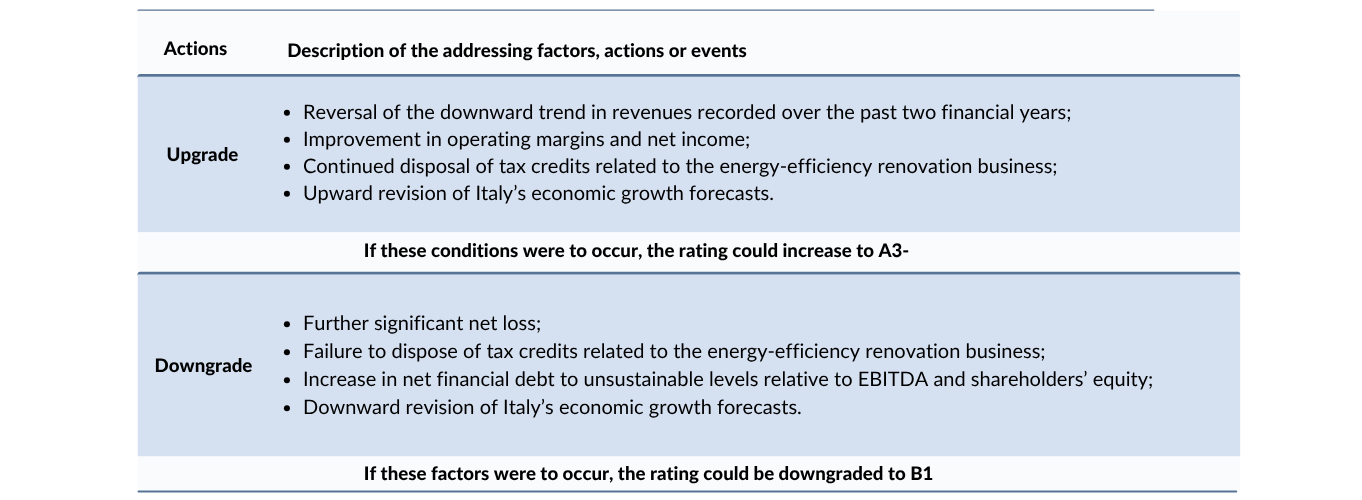
In the following table, the addressing factors, actions or events that could lead to an upgrade or a downgrade are summarized:
Important
The present Corporate Credit rating is issued by modefinance under EU Regulation 1060/2009 and following amendments.
The present rating is solicited and is based on both private and public information. The rated entity and/or related third parties have provided all private information used. modefinance had access to some accounts and other relevant internal documents of the rated entity and/or related third parties. Solicited and unsolicited ratings issued by modefinance are of comparable quality, as the solicitation status has no effect on methodologies used. More comprehensive information on modefinance Corporate Credit Ratings are available at http://cra.modefinance.com/en
The present Corporate Credit Rating is issued on MORE Methodology 2.0 and Rating Methodology 1.0. A comprehensive description of both methodologies, as well as information on modefinance Rating Scale and Mappings, is available at http://cra.modefinance.com/en/methodologies.
For information on historical default rates of modefinance Corporate Credit Ratings please refer to ESMA Central Repository and ESMA European Rating Platform.
modefinance refers to default as a company under bankruptcy, or under liquidation status, or under administration or for which missed payments on a financial obligation are officially recorded.
The quality of the information available on the rated entity and used to determine the present rating was judged by modefinance as satisfactory.
Please note that modefinance does not perform any audit activity and is not in a position to guarantee the accuracy of any information used and/or reported in the present document. As such, modefinance can accept no liability whatsoever for actions taken based on any information that may subsequently prove to be incorrect.
The present credit rating was notified to the rated entity in order to identify potential factual errors, as prescribed by the CRA Regulation. No amendments were applied after the notification process.
The rated company purchased ancillary services from modefinance (preliminary rating). Modefinance guarantees that this purchase of ancillary activities does not constitute any conflict of interest.
The rating action issued by modefinance was performed independently. The analysts, members of the rating team involved in the process, modefinance Srl and its members and shareholders do not have any conflicts of interest in relation to the Rated Entity and/or Related Third Parties. If in the future a potential conflict of interest is identified in relation to the persons reported above, modefinance Ratings will provide the appropriate information and if necessary the rating will be withdrawn.
The present Credit Rating is an opinion of the general creditworthiness that modefinance issues on the rated entity, and should be relied upon to a limited degree. The issued rating is subject to an ongoing monitoring until withdrawal.
Contacts
Head Analyst - Elisa Graffi, Rating Analyst
elisa.graffi@modefinance.com
Responsible for Rating Approval - Giada D'Avenia, Rating Process Manager
giada.davenia@modefinance.com