Solicited Corporate Credit Rating for OFFICINE DI CARTIGLIANO SPA: B1- (Affirm)
modefinance published the Solicited Corporate Credit Rating of OFFICINE DI CARTIGLIANO S.P.A. on the website and the rating assigned to the entity is B1- (Affirm). The analysis revealed it is a company with adequate economic and financial situation, capable of withstanding adverse economic conditions in the medium and long term.
The core business of OFFICINE DI CARGLIANO S.P.A. (hereinafter also "the Company"), founded in 1961 in Cartigliano (VI, Italy), consists of the research, design, manufacture, and marketing of machinery for leather drying using hot-air, vacuum, and radiofrequency systems. Since the early 2000s, the Company has progressively diversified into the food and environmental sectors, developing plants for drying municipal and industrial sludge to reduce disposal costs. Its competitive positioning is supported by ongoing R&D activity, thanks to a dedicated facility of approximately 1,500 sqm, which led to the launch of a new low-temperature leather conditioning unit (AirBreeze) and the filing of the related patent application in 2025.
Key Rating Assumptions
Officine di Cartigliano S.p.A. closed FY2025 with revenues of 25.4 million euros (+19% YoY), also supported by an increase in environmental orders for waste drying, although still below the peak of 27.9 million euros recorded in 2023. Rising production costs limited the recovery in operating profitability, with the EBITDA margin standing at 7% in 2025 (11% in 2023). Interest coverage remains limited, although financial expenses decreased. Despite a marginal net profit, the Company shows adequate capitalization, with a stable capital base of 12.2 million euros. The Net Financial Position (NFP), however, increased from 11.4 million to 12.2 million euros as of December 2025, reflecting new medium- to long-term funding raised during the year. Although the NFP/EBITDA ratio remains elevated in 2025 (7.2x), management expects a significant deleveraging over the next two years, supported by strengthening operating profitability and a gradual reduction in short-term debt, with a ratio below 3x expected from 2027 onward. Cash and cash equivalents were unchanged, standing at 0.4 million euros as of December 2025. The recognition of the 4.9 million euros equity investment in Cartigliano Ricerche affected both investing and operating cash flows, the latter benefiting from the contribution of IP rights related to the environmental and food-grade radiofrequency segments. On the financing side, the Company rationalized its bank debt, extending its maturity profile and consolidating its debt positions.
In 2024, the Company adopted the one-tier governance model, with a Board of Directors supported by a Management Control Committee. Ownership is mainly attributable to Antonio Polato (46.58%) and Antonia Corner (38.42%), Chairman and Vice Chairman of the Board of Directors, respectively. In 2024, the Company raised share capital by 2 million euros and disposed of its equity investment in Cartigliano de México, generating a significant capital gain. In 2025, it completed a corporate reorganization, acquiring an 87.5% stake in Cartigliano Ricerche - valued at 4.9 million euros - through the contribution of a business unit and the intellectual property rights related to the environmental segment (sludge drying) and food-grade radiofrequency technology.
Officine di Cartigliano S.p.A. demonstrates a solid size positioning, with production value recovering in 2025 (+19% YoY). In terms of solvency, however, the Company's positioning relative to its peer group appears penalized by significant financial indebtedness. Profitability deteriorated markedly compared to 2024, a year that had benefited from significant non-recurring income. Peer group solvency indicators are at good levels and improving in 2025, particularly in terms of financial leverage. The sector shows a balanced relationship between sources and uses of funds; despite the high proportion of inventories within the peer group's working capital, the median quick ratio remains above 1 throughout the period under review. Nevertheless, sector profitability remains at contained levels in 2025, although it has broken the downward trend observed between 2022 and 2024.
The tanning, footwear, and leather goods technology sector has been in recession since 2023. The sector closed FY2025 with output down to 512 million euros (-11% YoY). The sharpest contraction affected tanning machinery (-24.49%), followed by leather goods machinery (-9.8%) and footwear machinery (-4.1%), while spare parts and maintenance remained stable. While exports remain the sector's main growth driver, the structural transformation of global markets is reshaping the competitive landscape: China, supported by public support levels up to eight times higher than the OECD average, reached a 49% share of global trade in 2025, while Italy recorded a 27% share, underpinned by its leadership in tanning, leather goods and spare parts machinery. This external competitive pressure is compounded by the risk of erosion of Italy's domestic finished-goods manufacturing base, which could over time reduce the domestic customer base for the technology segment. According to Assomac, the sector's recovery requires an industrial policy that fosters investment, closer supply chain integration, and stronger internationalization supported by ICE, SACE, SIMEST and CDP, alongside sustained investment in innovation.
The ECB’s macroeconomic projections published in March 2026 indicate that euro area headline inflation is expected to rise to 2.6% in 2026, mainly driven by higher energy prices linked to the war in the Middle East, before easing to 2.0% in 2027 and 2.1% in 2028. Disruptions in commodity markets are weighing on real incomes and confidence, negatively affecting consumption and investment. In particular, annual real GDP growth is expected at 0.9%, 0.3 percentage points lower than in the previous December projections, while growth for 2027 and 2028 is estimated at 1.3% and 1.4%, respectively. Over the medium term, domestic demand will remain the main driver of growth, supported by a stable labor market, planned public spending on defense and infrastructure, and the continuation of digitalization and the AI-driven investment cycle. On the external side, structural competitiveness challenges will result in a persistent loss of market share for the euro area. The current energy crisis underscores the need for a green transition to reduce dependence on fossil fuels. Strengthening competitiveness and financial integration in Europe will also require the prompt regulation and adoption of the digital euro.
Sensitivity Analysis
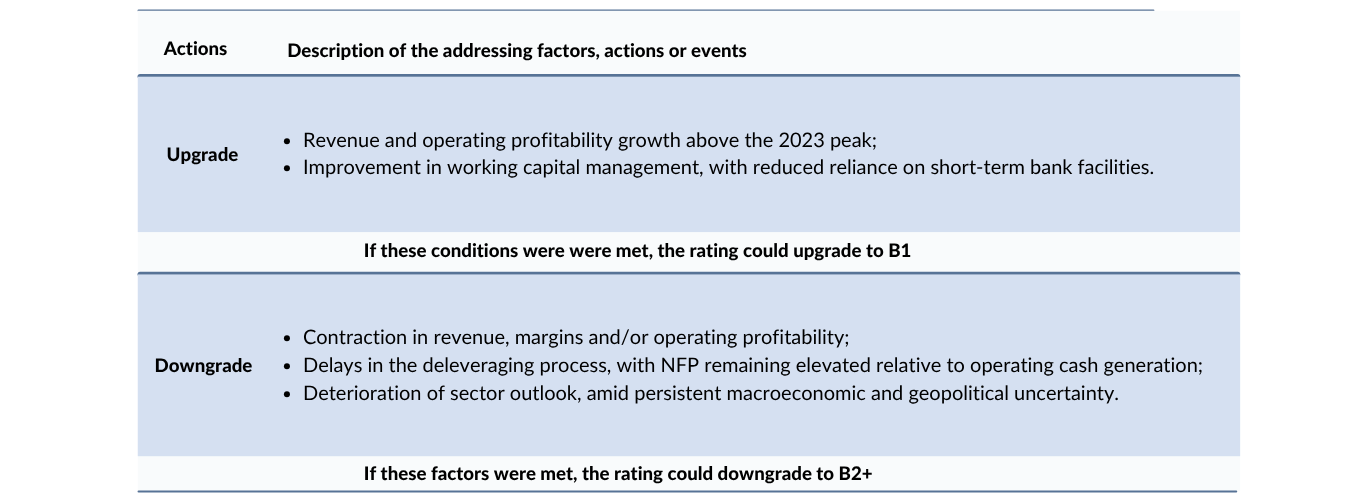
In the following table, the addressing factors, actions or events that could lead to an upgrade or a downgrade are summarized:
Important
The present Corporate Credit rating is issued by modefinance under EU Regulation 1060/2009 and following amendments.
The present rating is solicited and is based on both private and public information. The rated entity and/or related third parties have provided all private information used. modefinance had access to some accounts and other relevant internal documents of the rated entity and/or related third parties. Solicited and unsolicited ratings issued by modefinance are of comparable quality, as the solicitation status has no effect on methodologies used. More comprehensive information on modefinance Corporate Credit Ratings are available at http://cra.modefinance.com/en
The present Corporate Credit Rating is issued on MORE Methodology 2.0 and Rating Methodology 1.0. A comprehensive description of both methodologies, as well as information on modefinance Rating Scale and Mappings, is available at http://cra.modefinance.com/en/methodologies.
For information on historical default rates of modefinance Corporate Credit Ratings please refer to ESMA Central Repository and ESMA European Rating Platform.
modefinance refers to default as a company under bankruptcy, or under liquidation status, or under administration or for which missed payments on a financial obligation are officially recorded.
The quality of the information available on the rated entity and used to determine the present rating was judged by modefinance as satisfactory.
Please note that modefinance does not perform any audit activity and is not in a position to guarantee the accuracy of any information used and/or reported in the present document. As such, modefinance can accept no liability whatsoever for actions taken based on any information that may subsequently prove to be incorrect.
The present credit rating was notified to the rated entity in order to identify potential factual errors, as prescribed by the CRA Regulation. Some amendments were applied to the content of the credit rating report(s) or press release(s) after the notification process. The rated entity is not a buyer of ancillary services provided by modefinance. Modefinance ensures that such situation does not imply a conflict of interests in the issuance of the present credit rating.
The rating action issued by modefinance was performed independently. The analysts, members of the rating team involved in the process, modefinance Srl and its members and shareholders do not have any conflicts of interest in relation to the Rated Entity and/or Related Third Parties. If in the future a potential conflict of interest is identified in relation to the persons reported above, modefinance Ratings will provide the appropriate information and if necessary, the rating will be withdrawn.
The present Credit Rating is an opinion of the general creditworthiness that modefinance issues on the rated entity and should be relied upon to a limited degree. The issued rating is subject to ongoing monitoring until withdrawal.
Contacts
Head Analyst - Carmela Santomarco, Rating Analyst
carmela.santomarco@modefinance.com
Responsible for Rating Approval - Giada D'Avenia, Rating Process Manager
giada.davenia@modefinance.com